
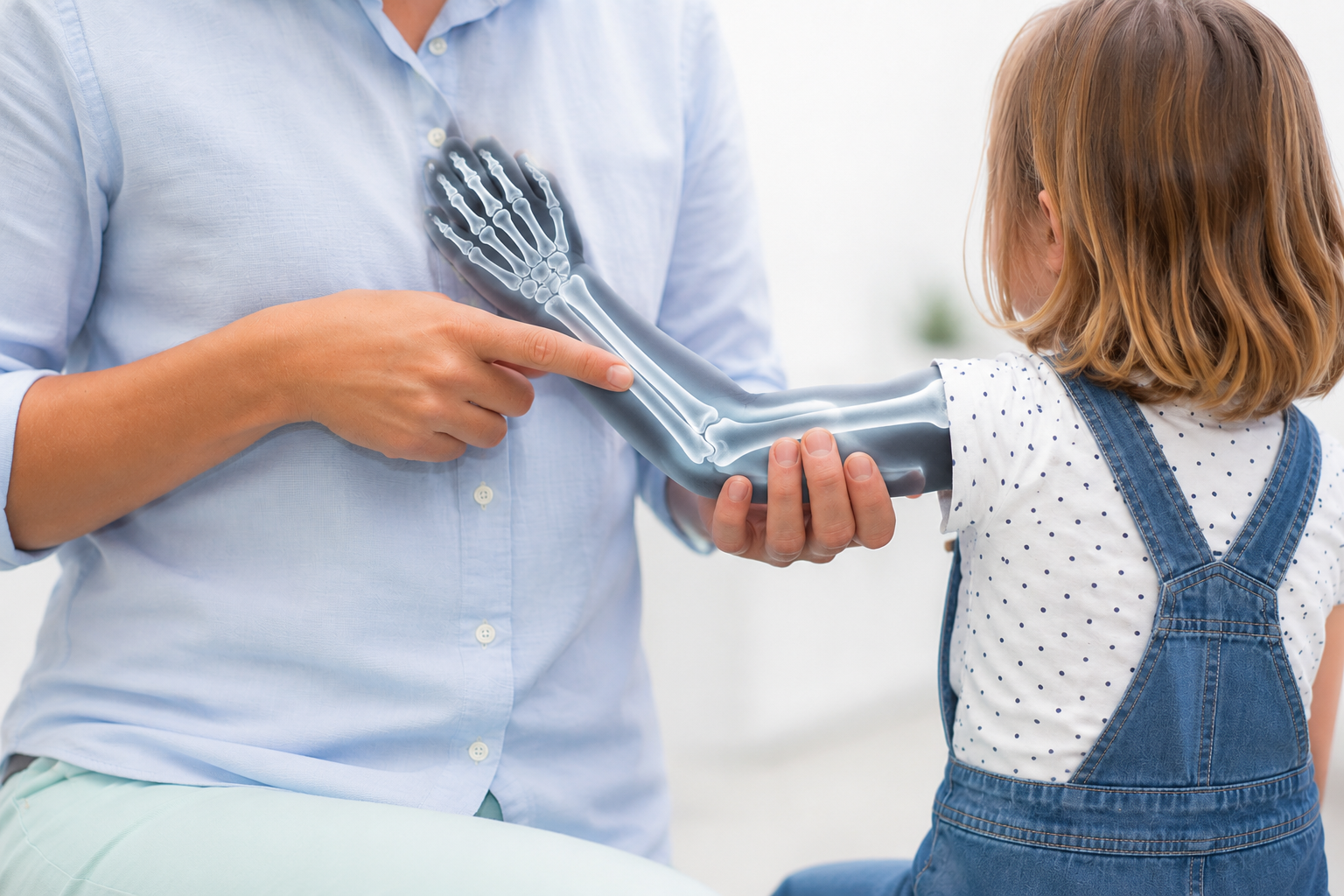
The playground at Wakad was filled with the usual chaotic joy of toddlers, but for Anjali, the atmosphere felt heavy with a growing sense of dread. She watched her two-year-old son, Ishaan, attempt to join a game of tag. While the other children pivoted and sprinted with ease, Ishaan’s movements were laboured. Every few steps, his knees seemed to pull toward each other, clicking together in a way that made him stumble and retreat to the sidelines. “Is he just clumsy?” she whispered to herself, “Or is his body growing in a way that will permanently sideline him?”
The suspense of not knowing if this was a simple phase or the start of a lifelong deformity kept her awake at night. She had seen adults with severe gait issues and wondered if she was witnessing the silent beginning of that same path for her son. Fearing that “waiting and watching” would eventually lead to a traumatic, bone-shattering surgery with months of recovery, she finally sought answers at Orange Health Care (OHC).
The Science of Milestones: Identifying the Golden Window
Movement issues in toddlers are often subtle, hiding behind the natural wobbles of early walking. However, the “science” of paediatric orthopaedics teaches us that a child’s musculoskeletal system is highly adaptable, or “plastic,” during these early years. This plasticity means that identifying a red flag early allows a specialist to “guide” the growth of bones and joints back to their natural alignment. When subtle signs like an unusual gait or asymmetrical movement are caught during the toddler phase, they can often be corrected using minimally invasive techniques that avoid the trauma of traditional open surgeries.
At Orange Health Care, experts like Dr. Rajeev Nirawane emphasize that ignoring these early signs can lead the body to compensate in ways that affect the hips and spine long-term. Awareness of developmental milestones—such as when a child should be sitting independently or walking without excessive tripping—is a parent’s most powerful tool. If a child consistently falls behind these markers or shows a visible preference for one side of the body, it is a clear signal that the underlying structure needs a professional evaluation to prevent future complications.
Nurturing Bone Health Early
The foundation for a child’s ability to run and play is actually laid months before their first breath at our Clinic. During pregnancy, the structural blueprint for your baby’s skeleton is determined by your internal environment and nutrition. Ensuring adequate intake of Calcium and Vitamin D is vital for the development of strong, healthy bones. Furthermore, expectant mothers should stay informed about fetal positioning; limited space in the womb can sometimes lead to manageable conditions like Torticollis (a neck tilt) or Clubfoot. By coordinating with our orthopaedic team for a baseline check immediately alignment after a Normal Delivery or Caesarean Delivery, you ensure that any “silent” orthopaedic concerns are addressed before your child ever attempts their first step.
The Resolution: A Confident Path Forward
Anjali’s decision to trust her instincts changed the trajectory of Ishaan’s life. A detailed gait analysis at Orange Health Care revealed a minor issue that was corrected quickly and effectively using the latest technology. The suspense that had once kept her on the sidelines was gone, replaced by the sight of Ishaan sprinting across the grass—steady, balanced, and full of life. Early intervention isn’t about looking for flaws; it’s about clearing the path so your child can move through the world with happiness and confidence.
Early Red Flags & Solutions at Orange Health Care
By recognizing these signs early, parents can access specialized, high-tech solutions at OHC that prioritize a child’s comfort and long-term health:
- Asymmetrical Movement: Consistently favouring one limb while crawling or pulling to stand, which requires a baseline orthopaedic review.
- Knock Knees (Genu Valgum): An inward tilt of the knees where they touch while the ankles stay apart; this can often be corrected through minimally invasive “Guided Growth”.
- Visible Foot Deformities: Feet that appear twisted or rigid at birth, signifying Clubfoot (CTEV), which is best treated during the earliest weeks of life.
- Persistent Head Tilt: A baby who always looks in one direction, potentially indicating Torticollis, which can lead to facial asymmetry if not addressed.
- Muscle Tone Concerns: Limbs that feel unusually stiff or excessively “floppy,” which are critical early indicators for conditions like Cerebral Palsy.
- Delayed Milestones: Not attempting to stand by 12 months or walk independently by 18 months.
For expert paediatric orthopaedic care, families can visit Orange Healthcare
Address: 110, Khinvasara Trade Center, Datta Mandir Road, Mangal Nagar, Thergaon, Pimpri-Chinchwad, Maharashtra 411033
Mobile no.: +91 7888038037
Email:
[email protected]
Explore Our Specialized Services: